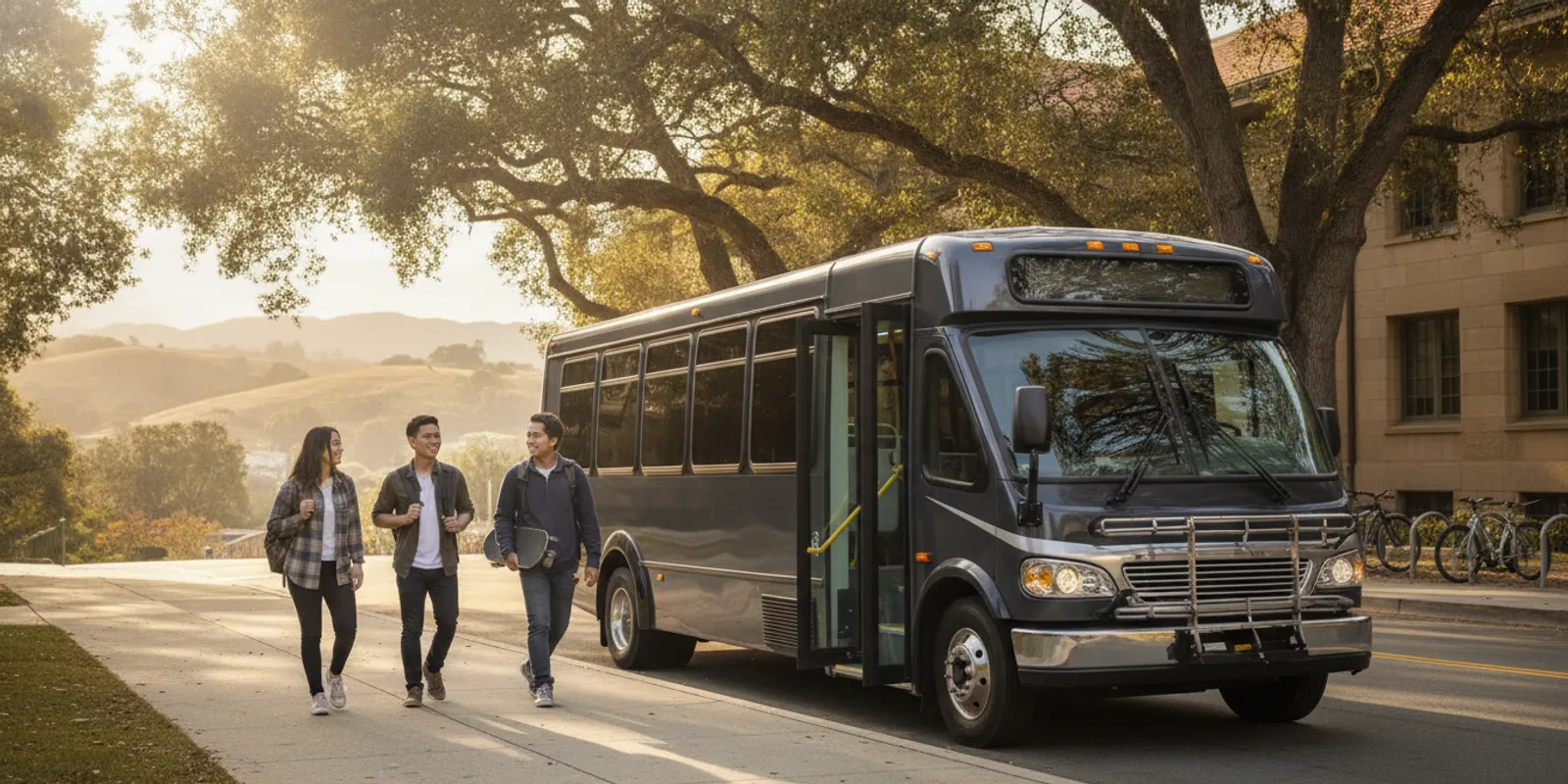
A charter bus in Sunnyvale can make office travel, campus transfers, conferences, and group outings easier to coordinate by keeping passengers on a shared schedule. Choose the vehicle and pickup plan around your headcount, luggage, stops, and arrival deadline. Confirm the exact address and loading instructions before travel day so the group knows where to meet.
Request a Quote and discuss your Sunnyvale trip with Epic Limousine. Call (415) 799-2744 for assistance.

Start with the purpose of your Sunnyvale trip
The best bus plan starts with the trip’s job, not simply the passenger count. Corporate commutes, conference transfers, school trips, and private events have different timing, luggage, and pickup needs.
Sunnyvale groups may be traveling between an office, hotel, meeting venue, campus, airport, or an event elsewhere in the Bay Area. Write down every required stop, the time people must arrive, and whether the bus should wait or return later. For recurring office transportation, note the days, shifts, and pickup windows; for a one-day gathering, identify the event start and end times.
For technology-company travel, coordinate the route around actual employee origins and worksite access rather than assuming everyone starts at one central location. A shuttle might bring employees from a designated transit or parking meeting point, move attendees among a hotel and conference venue, or carry a team to an off-site. For a larger event, first confirm the destination’s loading access, stop order, and boarding window. A convenient map pin does not always identify an approved bus loading zone, so ask a site contact where a full-size vehicle can safely enter and wait. For repeat service, a brief site review can surface access questions before the first operating day. Also identify one organizer who can authorize schedule changes and communicate them to passengers. An organizer considering a recurring campus or company route can review the employee shuttle planning guide for useful route and communication questions.
Campus travel calls for the same clear plan. Decide whether students or guests need a single drop-off or several stops, and give the driver an approved entrance and staging location. For college and university groups, compare the trip needs with college and university transportation options. School groups can also review field trip bus planning.
Be specific about the purpose when asking for a quote. “A bus for our office” leaves open whether you need one departure, an all-day shuttle loop, or service across several shifts. Instead, describe who is traveling, what locations they need to connect, and what time constraints cannot move. For a campus visit, identify whether the group is a class, a prospective-student group, employees, or conference guests; each may have different boarding and supervision arrangements. For an event, decide whether the bus is simply a transfer or whether it needs to remain available between the outbound and return trips.
Choose a vehicle by usable capacity and trip pattern
Choose a vehicle that can carry the full group comfortably with its luggage, equipment, and planned route. Ask about passenger capacity for the specific vehicle, not just a broad vehicle category.
Passenger count is only one part of the decision. A work team with backpacks may fit differently from airport travelers with rolling suitcases, and a sports group may have bulky equipment. A single direct transfer usually has different needs from an all-day itinerary with several pickups. Review the available fleet and share the complete trip details when requesting a recommendation.
| Trip pattern | Vehicle planning focus | Details to confirm |
|---|---|---|
| Small executive or project team | Comfortable seating for a compact group and workday bags | Passenger total, pickup sequence, and whether there are multiple stops |
| Conference or office shuttle | Capacity and boarding flow for repeated runs | Peak passenger volume, service window, stop order, and wait times |
| Airport group transfer | Seats plus space for each traveler’s luggage | Flight schedule, airport, terminal instructions, and bag count |
| School or campus trip | Capacity that accommodates the group and its trip requirements | Student count, adult supervision plan, approved loading point, and schedule |
| Private event or day trip | Group size, personal belongings, and time spent aboard | Event access, return time, stops, and where passengers will gather |
For a larger group, a motor coach group trip may be a relevant option to discuss. If you are comparing vehicle sizes and rental structures, the charter bus price guide and motor coach rental pricing guide can help you identify questions to include in a quote request. Actual pricing depends on your trip details; request a tailored quote rather than relying on a generic estimate.
Think of capacity as a planning range, not a number to fill to the last seat without considering comfort or belongings. Ask whether the quoted capacity refers to passenger seats, and explain whether riders will bring luggage, presentation materials, sports gear, or other bulky items. For a round trip with different passenger counts on the way back, share both numbers. If the group is still growing, state the current headcount and the date you expect to finalize it. That gives the provider a clearer basis for discussing a suitable vehicle and whether a later update may change the plan.
Also distinguish between the size of the full invited group and the number riding on any one trip. A conference may have many registered attendees but only a portion using the shuttle at once. A team outing may have everyone departing together, then splitting into smaller groups for separate return times. These differences affect vehicle use and schedule design, so include the peak load and any split departures in your request.
Plan office shuttles and conference transfers around real demand
Office and conference transportation works best when the schedule reflects when people will actually travel. Build the plan around arrival waves, meeting times, and the time needed to board at each stop.
For an employee shuttle, establish the service days, operating hours, pickup locations, and expected passenger volume for each run. Consider whether demand is heavier at the beginning and end of the workday, and tell the provider if the number of riders may vary. A recurring shuttle plan should also specify who updates the schedule and how riders learn about changes. Epic Limousine’s employee shuttle service information can be a starting point for discussing a recurring arrangement.
For conferences, set out which hotels or meeting points the service will connect, when sessions begin, and when attendees are likely to return. A loop with several stops needs enough time for traffic, loading, and passengers who arrive just after a departure. Make the route and timetable easy to share, and identify a day-of contact who can relay a change. See the corporate event transportation guide or the conference shuttle planning guide for additional planning prompts.
When estimating shuttle frequency, start with the arrival time people need to meet, then work backward. Include time for a vehicle to reach the pickup point, load passengers, and complete the route. Do not assume that a bus can make a loop instantly because two locations look close on a map. Ask the organizer or venue about event access and loading flow, then discuss a schedule that leaves room for ordinary delays. If arrivals are spread over a long period, a series of planned runs may be easier for riders to understand than an informal, continuous loop.
For a recurring commuter service, treat the schedule and passenger communications as one plan. Share a standard timetable, name the person responsible for updates, and set a clear cutoff for same-day changes. If a pickup is temporarily unavailable or a stop moves, issue one revised set of instructions through the agreed channel. Keep the passenger-facing message short: date, stop, departure time, and what changed. For conferences, post a concise route and departure timetable where attendees can find it, and give staff a copy so they can answer basic questions consistently.
Coordinate airport transfers and pickup points carefully
Airport group transfers need a firm passenger count, a flight-aware schedule, and precise instructions for where the group meets. Confirm the airport, terminal, arrival or departure time, luggage volume, and pickup procedure before finalizing the itinerary.
Sunnyvale trips may connect with SFO, OAK, or SJC, depending on travelers’ flights and plans. Avoid planning a single pickup around an assumed arrival time if the group is landing on different flights. Provide flight details where available, decide whether travelers will meet at one agreed location, and clarify how the group will communicate if a flight changes. For a coordinated group ride, explore group airport shuttle transportation and Oakland airport transportation information.
For arrivals, set an agreed check-in point and communicate how the organizer will confirm that the group is assembled. If travelers arrive on separate flights, decide whether to group them into waves or plan separate pickups instead of asking early arrivals to wait without a clear update. For departures, build the route backward from the required arrival time, allowing time to gather passengers and load bags. At an office, hotel, school, or venue, give passengers a recognizable meeting point and the exact address. Tell the transportation provider about gates, loading zones, security procedures, or restrictions you already know. If a location has more than one entrance, state which one the group should use. Add a short buffer for boarding and traffic instead of scheduling the vehicle to arrive at the same minute as the meeting begins.
For a group departure, decide who will verify that everyone is present before the bus leaves. One person can check names against a simple passenger list while another watches for late arrivals, but the roles should be assigned before travel day. Keep flight details and pickup instructions in the same itinerary document so the organizer does not have to reconcile separate messages. If some travelers are meeting the group at the airport and others are boarding in Sunnyvale, show both boarding points and their planned times clearly. Share what passengers should do if their flight changes, but avoid promising a pickup adjustment until the revised plan has been confirmed.
A campus destination may have its own visitor guidance, entrances, and event procedures. For general destination context when arranging a Bay Area campus visit, the University of California, Berkeley provides visitor information about student life; confirm transportation access and bus loading directly with the specific destination. That distinction matters: general visitor information can help guests prepare for a visit, but it does not substitute for a transportation or loading approval.
Make pickup and travel-day instructions easy to follow
A simple day-of plan reduces confusion for both passengers and the organizer. Send one set of instructions with the pickup address, time, vehicle identification details when available, stop order, and a contact person.
Use this checklist before confirming your Sunnyvale charter:
- Confirm the total passenger count and identify any likely changes.
- List every pickup, drop-off, return trip, and planned stop in order.
- Share exact addresses, entrance details, and approved loading locations.
- Estimate luggage, equipment, and other items that need room.
- Set arrival times and include practical boarding and traffic buffers.
- Name one organizer and share a day-of contact method with the group.
- For repeat service, confirm operating days, hours, and the process for schedule updates.
- For airport rides, share the airport, flight details, and group meeting instructions.
- Identify any passengers who need specific boarding assistance and discuss logistics in advance.
For school trips, define who is responsible for student supervision and verify the school’s own travel procedures. For any group, decide how the organizer will handle late arrivals, forgotten belongings, or a passenger who needs help finding the meeting point. Share a single itinerary version, especially when plans change, so passengers do not follow conflicting pickup times. If several people are coordinating different legs, give each person the same final schedule and the same day-of contact details. A brief reminder shortly before departure can restate the departure time and location without burying those essentials in a long itinerary. For events, explain where passengers should wait after the program and how the return departure will be announced. When a trip includes leisure stops or sightseeing, consider the group’s schedule alongside city tour transportation options. A broader charter bus planning guide may also help organizers prepare their questions.
Make the meeting place easy to describe to someone who has never visited the site. “Front entrance” may be ambiguous at a large office or campus. Add a building name, street-side landmark, gate, or approved loading area, and include a map pin only as a supplement to the written address. If the vehicle cannot wait at the curb, tell passengers where to gather and how they will be notified when boarding begins. Share these instructions in the same format with every rider, rather than relying on one person to forward a chain of messages.
It also helps to identify a backup communication method. A group chat may work for some trips, while a school or company may have a required channel. Decide who monitors replies and who can contact the provider if the route or schedule needs attention. Give passengers a realistic arrival instruction, such as being at the designated point before the planned departure, and explain whether the vehicle will leave at the stated time. Clear expectations help prevent the whole group from waiting while an organizer searches for one late passenger.
Request a quote with enough detail to plan the trip
A useful quote request describes the itinerary, schedule, and group—not just the pickup city. Sharing details early makes it easier to discuss a vehicle and service plan that fits the trip.
Organizers can make the request more actionable by separating fixed requirements from preferences. For example, a meeting start time and an approved entrance may be firm, while a hotel pickup or sightseeing stop may still be under consideration. State which details are final, which are estimates, and when you expect to confirm the rest. For shuttle service, distinguish the total number of employees from the number expected on each run; for a one-time event, distinguish the invited group size from the riders who need transportation. This context helps surface capacity, timing, and route questions before the itinerary is set.
Include your travel date, start and end times, passenger count, origin and destination addresses, intermediate stops, and whether the bus is needed for a one-way transfer, round trip, hourly charter, recurring shuttle, or multiple-day schedule. Add luggage or equipment estimates and any known venue or airport loading instructions. If details are tentative, say what is confirmed and what may change.
Before submitting, check that the itinerary answers a few practical questions: Is the vehicle needed to wait, or should it return at a later time? Does the group need one pickup or several? Is a return trip included, and will it leave from the same place? Are there a few riders with unusually large bags or equipment? If you do not yet know an answer, label it as open rather than leaving it out. That lets the provider distinguish a missing detail from a detail that is still being decided.
Epic Limousine serves the San Francisco Bay Area with transportation options ranging from luxury sedans to motor coaches. Review Epic Limousine’s transportation services, then share your requirements to discuss a suitable arrangement. You can also learn more about Epic Limousine and its service approach.
Request a Quote for your Sunnyvale group itinerary. Call (415) 799-2744 for assistance.
Frequently asked questions
How far in advance should I request a charter bus in Sunnyvale?
Request a quote as soon as you know the date, schedule, and approximate passenger count. Earlier planning gives you more time to confirm the vehicle, pickup locations, and any venue or airport requirements. For recurring shuttles, share the expected service period and operating schedule.
What information should I provide for an office shuttle quote?
Provide service days and hours, pickup and drop-off locations, expected riders per run, route order, and whether the schedule repeats. Include shift or arrival patterns and identify how you expect to communicate schedule changes. If ridership is still being estimated, explain that in your request.
Can a charter bus handle an airport transfer for a group?
Yes, a group transfer can be planned around the airport, flight schedule, passenger count, and luggage. Tell the provider whether the group is arriving together or on separate flights, and agree on a meeting location and pickup procedure in advance.
How do I choose the right vehicle size?
Start with the number of passengers, then account for luggage, equipment, and how many stops the trip includes. Ask about the capacity and available space of the specific vehicle being considered. The fleet overview can help you discuss options.
Can I plan several stops or a return trip?
Share every stop and the expected time at each location when requesting a quote. State whether the vehicle should wait, make a later return, or run a repeated loop. A complete itinerary is more useful than a single origin and destination.
What should passengers know before pickup?
Send the exact address, meeting point, departure time, stop sequence, and organizer’s contact information. Explain how early passengers should arrive and what to do if they are delayed. For a large group, share the same written instructions with everyone.
Request a quote for your Sunnyvale group trip
Whether you are coordinating a company shuttle, conference transfer, airport ride, campus visit, school outing, or private event, a clear itinerary is the foundation of a smooth trip. Epic Limousine can discuss the vehicle and service pattern that match your group’s plan.
Request a Quote for charter bus service in Sunnyvale, or call (415) 799-2744 to discuss your transportation needs.
Confirm the passenger list, addresses, timing, and day-of contact before the trip so everyone knows where to go and when to be ready.