
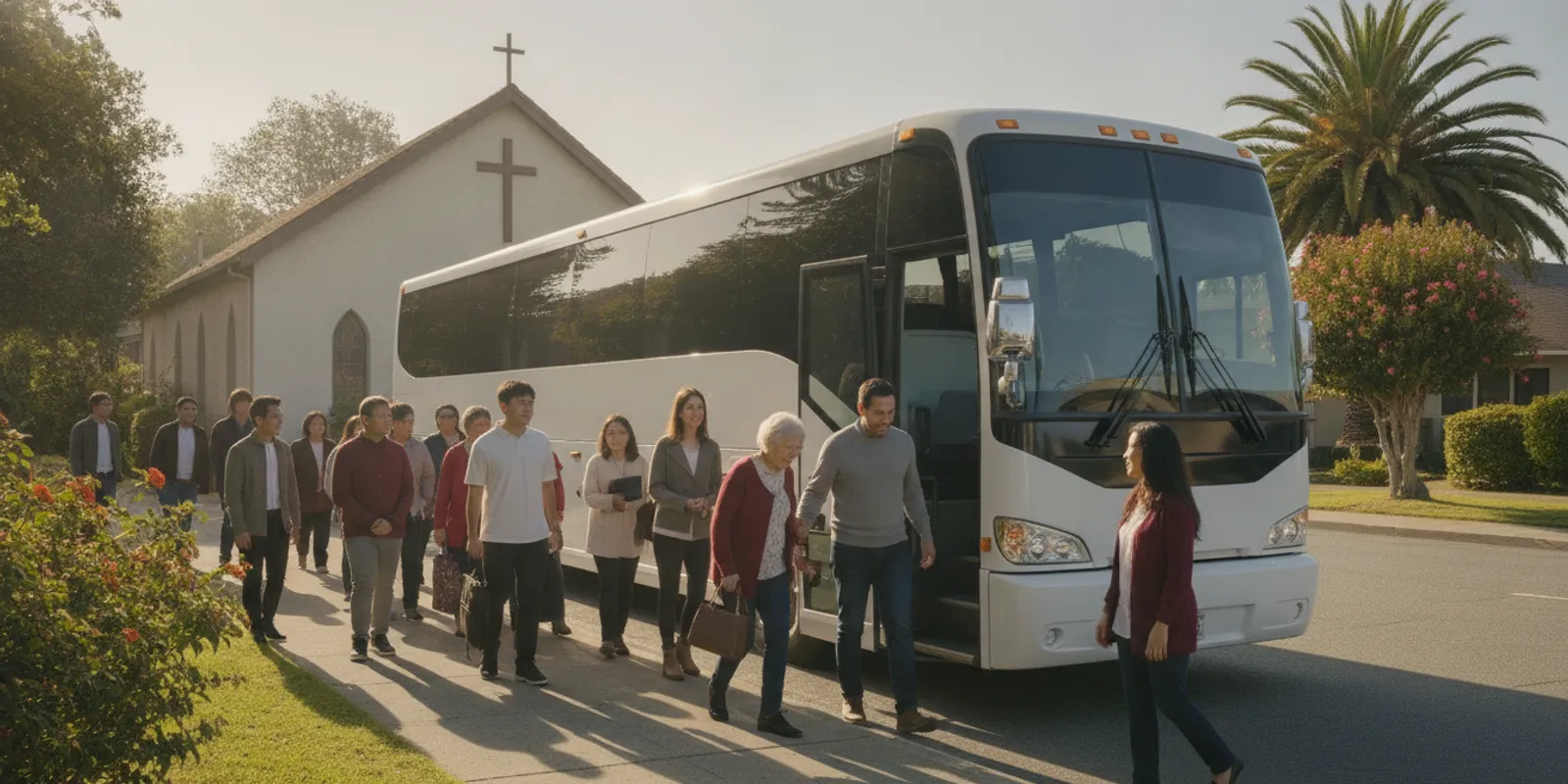
A church group bus rental can bring worship trips, retreats, conferences, and volunteer outings into one coordinated travel plan. Begin with a confirmed route, a realistic headcount, and the needs of the people traveling. Then assign a trip lead and share clear timing and pickup instructions with the provider and passengers.
What should you decide before requesting a bus?
Define the purpose, passenger estimate, route, and required arrival time before comparing transportation options. Those basics help a provider understand the service rather than guess from a date and destination alone.
Church outings often have different travel rhythms. A worship service may have a firm start time and a brief unload. A retreat may involve luggage, a longer ride, and a late return. A volunteer outing could need several pickups or a stop for supplies. Write down the purpose and the trip’s non-negotiable details first.
- Trip date, departure time, and the time the group must arrive.
- Pickup address and a practical place for the vehicle to wait.
- Destination address, venue entrance, and planned stops.
- Estimated passenger count, including leaders and chaperones.
- Expected return time and whether the group stays together throughout.
- Mobility, seating, luggage, equipment, or other passenger needs.
- Who can approve changes and who will communicate them.
Choose one coordinator and one backup. Keep the latest itinerary and passenger estimate in a shared, access-controlled document. A single source of truth helps prevent volunteers, passengers, and the provider from working from different versions. Review Epic’s fleet information and charter bus guide as you frame the vehicle and trip questions.
How should you organize the passenger manifest?
A useful manifest gives trip leaders a dependable headcount without collecting more personal information than the trip requires. Decide who maintains the roster, who can see it, and how leaders will confirm passengers at each departure.
Set a registration deadline that leaves time to confirm the group size and update the transportation plan. Record names and only the practical details a designated leader needs, such as a minor’s assigned adult or a mobility request. Avoid placing private medical or family information on a roster that many volunteers can access. Share sensitive details separately and only with the people who need them to help plan the trip.
- Assign one person to update the master list and note when it was last revised.
- Organize the roster by family, youth group, volunteer team, or another useful unit.
- Identify each minor’s parent, guardian, or approved chaperone under congregation policy.
- Give team leads a way to report changes without editing multiple copies.
- Set the check-in method for initial boarding and every later departure.
- Clarify how late arrivals, cancellations, and emergency-contact updates are handled.
- Compare the final headcount with the requested vehicle arrangement before travel.
For a large group, team leads can count their assigned passengers and report totals to the coordinator. That is usually easier to reconcile than asking every passenger to make changes directly. Keep a copy available to the trip lead, but do not post names and contact details in a public group chat. The American SPCC charter-bus planning resource is another reference for group leaders reviewing important trip arrangements.
What accessibility and comfort needs should you confirm?
Ask about access needs early, then discuss the practical arrangements directly with the provider. Confirm the features and boarding plan for the proposed vehicle instead of assuming that a particular accommodation is available.
Consider the whole trip, from the congregation’s gathering point to the final drop-off. Is the pickup area level and easy to reach? Will anyone need additional boarding time or help getting to the vehicle? Does a passenger use a mobility device? Could the route or time between stops create a concern? Share the information necessary to plan, while respecting passenger privacy.
| Planning area | What to confirm | Why it matters |
|---|---|---|
| Boarding access | Pickup surface, approach, boarding time, and mobility-device needs | Helps the group plan an appropriate gathering point and boarding routine |
| Seating | Passenger count, seating arrangement, and any designated-seat requests | Aligns the proposed arrangement with the people traveling |
| Trip length | Expected time between stops and whether comfort breaks are needed | Sets practical expectations for longer journeys |
| Onboard features | Whether climate control, Wi-Fi, or entertainment is available on the proposed vehicle | Prevents the group from promising unconfirmed amenities |
| Pickup site | Safe waiting space, curb access, and room for the vehicle to approach | Reduces confusion and congestion during boarding |
Epic describes fleet amenities that can include Wi-Fi, climate control, and entertainment systems, but features depend on the vehicle. Ask which features are confirmed for the arrangement under discussion before telling passengers what to expect. When planning travel for a school-age or student group, Epic’s field trip transportation guide offers another group-planning reference. You can also review the motor coach group travel information and ask specific questions about fit and access.
How can congregations plan for children and youth?
Use the congregation’s safeguarding policies to assign supervision, manage boarding, and handle changes during the trip. Transportation planning supports those policies; it does not replace them.
Before departure, identify which adults are responsible for each youth group and who may make decisions if plans change. Explain check-in, boarding, and communication procedures to families and participants. Set expectations for staying with an assigned group, leaving the vehicle only with permission, and reporting a concern to a designated leader.
- Confirm parent or guardian permissions through the congregation’s normal process.
- Assign chaperones and specify which young people each person supervises.
- Set a boarding and headcount method for departure and every stop.
- Share the itinerary, leader contact process, and expected return window with families.
- Agree how a late pickup, missing passenger, or schedule change will be handled.
- Keep emergency contacts with designated leaders and protect that information.
- Confirm any additional requirements with the congregation and venue before travel.
For an outing with multiple stops, name a meeting point and allow a time buffer at each location. A simple instruction such as “check in with your group lead before moving to the next stop” is easier to follow than relying on scattered messages. For a campus event or youth conference, organizers may also compare practical considerations in Epic’s college and university transportation information. The congregation should remain responsible for its own permission, supervision, and safeguarding decisions.
How should you build a schedule for worship trips and outings?
Build the schedule backward from the time the group must be ready at its destination. Allow for loading, traffic, headcounts, and transitions so the plan does not depend on every step going perfectly.
List each address alongside the expected arrival and departure times. Identify who will communicate with the venue and who will update passengers if the schedule changes. For a conference, include registration or session start time. For a worship service, allow time to unload passengers and materials. For a volunteer day, account for equipment, a briefing, or a check-in before work begins.
For each stop, record the following details:
- Full address and the best entrance or meeting point.
- Planned arrival and departure times, plus the latest acceptable arrival.
- How long the group expects to stay.
- Whether everyone boards and leaves together or in assigned groups.
- Parking, loading, or access instructions supplied by the venue.
- The person responsible for confirming that the group is ready to depart.
As a simple example, a congregation traveling to a morning conference should work backward from registration, not from the moment the vehicle is expected to arrive. Add time for check-in at the pickup, a passenger count, travel, and walking from the drop-off to registration. If registration opens at 9:00, the group may need to arrive before then; confirm the venue’s requirements and build a buffer around that target. Keep tentative stops clearly marked so nobody mistakes them for confirmed instructions. Epic’s charter bus planning guide and Bay Area charter planning information can help organizers prepare route questions.
Which vehicle details and amenities belong in the plan?
Match the arrangement to the passenger count and itinerary, then verify the vehicle and relevant features with the provider. A broad fleet description is not confirmation that a particular vehicle or amenity will be assigned.
Think about how passengers will use the ride. A short local outing may call for straightforward seating and an easy pickup. A retreat journey might make luggage space, comfort breaks, or climate control more important. A conference group may prioritize a predictable arrival and a clear way to keep attendees together. A volunteer outing may need room for permitted supplies or equipment, so describe those items rather than assuming they will fit.
Epic’s stated fleet spans vehicles with capacities from 3 to 56 passengers. That range does not establish availability or suitability for a specific trip. Give the provider the best passenger estimate, explain luggage and equipment needs, and raise access requirements. Ask what vehicle arrangement is proposed and which amenities are confirmed. A congregation should not choose by seat count alone if bags, mobility needs, or a split pickup plan affect the practical fit. Epic’s motor coach guide and large-group transportation guide provide additional prompts for discussing arrangements.
What should you include in a transportation quote request?
A specific request gives a provider the information needed to understand the route, timing, and expected service. Send confirmed details where possible and label estimates or open questions clearly.
Use this checklist to prepare the request:
- Congregation or organizing-group name and coordinator contact information.
- Trip date, approximate departure, required arrival, and return window.
- Passenger estimate and the date the final headcount should be available.
- Every pickup, destination, and planned stop, with full addresses if known.
- Expected wait time at each destination and whether the vehicle should remain available.
- Relevant access, boarding, luggage, equipment, or amenity considerations.
- Youth supervision logistics that affect boarding or timing, without oversharing personal details.
- Flexibility in departure time or route and the date details can be finalized.
Ask what service period the quote assumes, what vehicle arrangement is proposed, and how itinerary or passenger-count changes are handled. Review applicable deposit, payment, cancellation, and other terms before confirming. Because arrangements are quote-based, do not treat a generic online figure as a promise for the group’s trip. Epic’s charter bus cost guide can help frame cost questions, while its reservation information explains the next step. To discuss the actual itinerary, use the contact page.
How can you prepare the group for travel day?
Send passengers one concise message with the confirmed gathering point, schedule, leader contact process, and what to bring. Recheck the roster and itinerary with the provider before departure.
Tell travelers when check-in begins and what to do if they expect to arrive late. Identify the trip coordinator and the person responsible for headcounts. Give passengers a practical way to receive updates, such as a message from the coordinator, rather than asking several people to contact the driver independently. Keep essential trip details easy to find, but do not broadcast private roster information to the full group.
- Confirm the passenger count and report any material change.
- Recheck addresses, venue entrances, and timing.
- Share the precise gathering point and time to arrive for boarding.
- Remind passengers to follow chaperone and group-leader instructions.
- Keep the itinerary and relevant provider contact details with the coordinator.
- Count passengers before leaving every stop and at the end of the trip.
For a recurring or complex itinerary, prepare a short change protocol. For example, the coordinator receives information from team leads, confirms the revised count, and then communicates a single update to the provider and group. This prevents multiple versions of a new pickup time from circulating. If the group needs a shuttle-style plan for an event, Epic’s event shuttle planning guide may help identify additional questions about moving passengers between locations.
Frequently asked questions
These answers cover common planning questions. Final arrangements depend on the itinerary and the vehicle details confirmed with the provider.
How early should a church reserve group transportation?
Start when the date, route, and likely passenger count are known. Early preparation gives organizers time to gather needs and discuss options, but availability is not confirmed until the provider confirms the booking.
Can one trip include several stops?
Yes, organizers can ask about a multi-stop itinerary. Include every planned location, the expected time at each stop, and whether the vehicle needs to wait. Confirm the route and any change process before sharing final instructions with passengers.
What if the passenger count changes?
Ask when the final count is due and how a change could affect the vehicle arrangement or quote. Keep one coordinator responsible for sending updates so the provider receives a consistent estimate.
Can a congregation request accessibility arrangements?
Raise access needs early and discuss the specific requirements with the provider. Confirm what is available for the proposed vehicle and pickup location rather than assuming that a feature or arrangement is included.
What should parents know about a youth outing?
Share the schedule, pickup and return expectations, supervision plan, and method for contacting the designated leader. Follow the congregation’s permission and safeguarding procedures and provide only appropriate trip information to families.
What information helps produce a useful quote?
The date, passenger estimate, full addresses, timing, stops, expected service period, and relevant access or equipment needs give the provider a practical starting point. Identify uncertain details so assumptions can be clarified.
Should the group promise passengers specific onboard amenities?
Only share features that have been confirmed for the proposed vehicle. Ask about amenities during planning, then update the passenger message if the details change.
Plan your church group’s trip
A clear manifest, realistic schedule, agreed supervision process, and complete quote request give a congregation a stronger starting point for arranging group transportation. Gather the trip details, confirm open questions with Epic Limousine, and share final instructions with passengers once the plan is agreed.