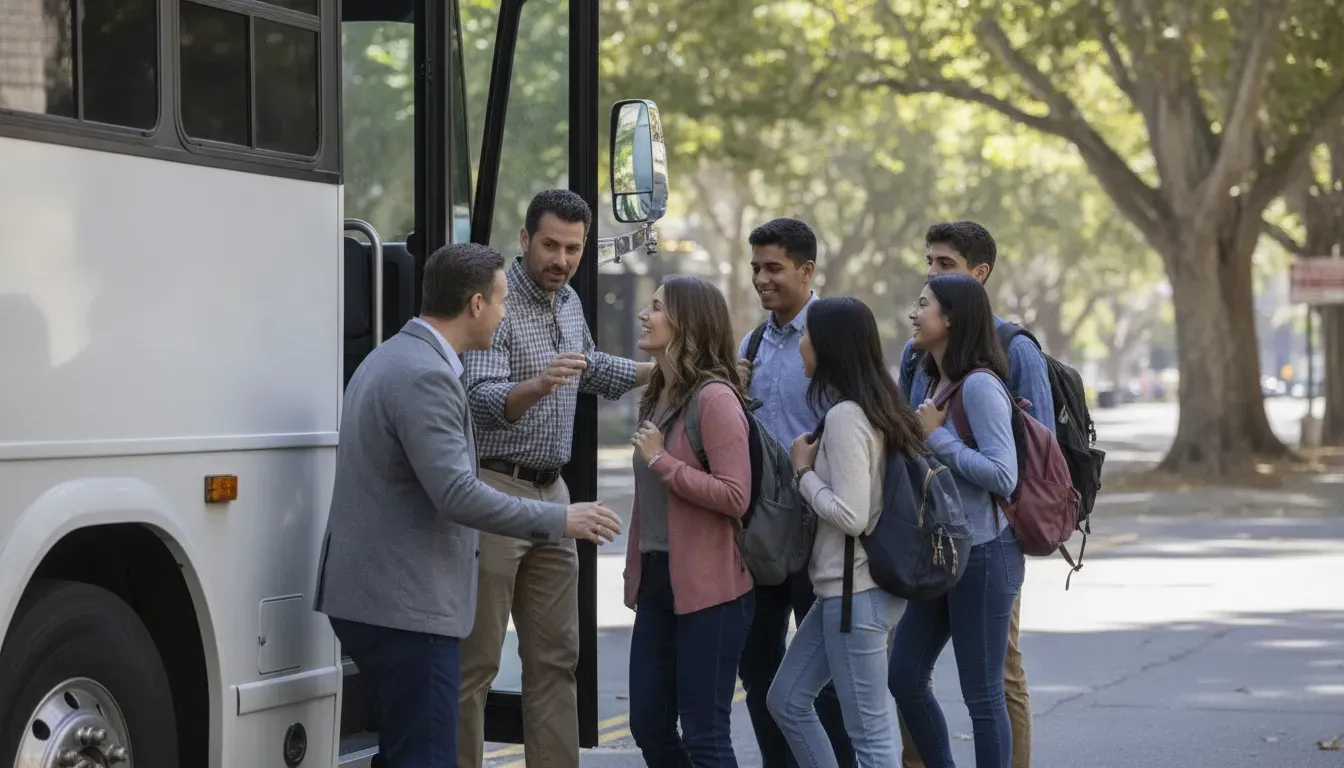
College group transportation for San Francisco events works best when the ride is planned as part of the event, not added after the venue and schedule are already fixed. A dependable plan connects campus, hotels, airports, event venues, and return points while keeping students together and giving coordinators clear control over timing. The right vehicle, pickup plan, and route buffer can make a full day easier for students, chaperones, faculty, and event staff.
Request a Quote for College Event Transportation
What is college group transportation for San Francisco events?
College group transportation for San Francisco events is pre-arranged travel for students, faculty, staff, guests, or athletic groups moving between a campus and one or more event locations. It combines vehicle selection, passenger accountability, pickup coordination, route planning, and event-day communication into one transportation plan.
That coordinated approach is useful for orientation programs, academic conferences, student organization trips, performances, athletic travel, commencement activities, and visits that involve more than one stop. Instead of asking every student to find a separate ride, the group follows a shared schedule with designated loading points and a clear return plan.
Epic Limousine supports this broader planning need through college and university transportation, while the existing college transportation bus rental planning guide covers general campus travel considerations. This guide focuses on the San Francisco event-day details that can affect access, timing, staging, and group movement.
Build the transportation plan around the event schedule
A strong college event transportation plan starts with the complete itinerary, including arrival windows, meal breaks, event check-in, dismissal, and the final return point. Planning those details first helps the transportation provider recommend a workable vehicle and route rather than simply quoting a point-to-point trip.
- Define the passenger group: Count students, faculty, chaperones, guests, performers, athletes, and any staff who will ride. Note whether the group will travel together or split across several vehicles.
- List every stop: Include the campus departure point, hotels, SFO or other airport arrivals, event venues, rehearsal spaces, meal locations, and the return destination. A route with several stops needs more coordination than a direct transfer.
- Set an arrival standard: Decide whether the group must arrive early for registration, security screening, equipment setup, or seating. The desired arrival time should leave room for unloading and walking from the vehicle staging point.
- Assign pickup leaders: Give one person responsibility for the passenger roster and one person responsibility for communication with the driver or transportation coordinator. Students should know where to gather and who to contact if they are delayed.
- Plan the return: Confirm whether the group leaves together, departs in waves, or needs a later vehicle for students finishing a performance, game, or meeting.
- Identify special requirements: Share accessibility needs, sports equipment, instruments, luggage, mobility devices, or other items that may affect seating and storage.
- Prepare a communication plan: Give the provider one current itinerary and one primary day-of contact. Send changes through that contact so the driver receives a consistent plan.
For a deeper route-building framework, see Epic’s guide to building a group transportation itinerary in San Francisco. The goal is not to schedule every minute without flexibility. It is to make the important handoffs visible before event day.
Choose a vehicle plan that matches the group
The best vehicle plan matches the passenger count, luggage or equipment, route length, accessibility needs, and event format. A smaller vehicle may suit a faculty delegation or guest group, while a larger charter bus can keep a full student organization or athletic group together.
| Event transportation need | Good-fit approach | Planning emphasis |
|---|---|---|
| Campus group traveling to one venue | One appropriately sized group vehicle | One loading zone, roster check, and scheduled return |
| Students arriving from several hotels | One vehicle with planned hotel pickups or coordinated vehicles | Pickup order, luggage space, and room for route changes |
| Athletic or performing arts group | Vehicle plan that accommodates people and gear | Equipment storage, loading time, and post-event departure |
| Conference or multi-venue program | Shuttle rotation or a scheduled group transfer | Staging locations, repeated loops, and a day-of coordinator |
| Small faculty, speaker, or guest delegation | Smaller luxury vehicle matched to the group | Privacy, schedule precision, and direct venue access |
Review the available Epic Limousine fleet with the itinerary rather than choosing by vehicle name alone. The useful question is whether the vehicle provides the capacity, storage, comfort, and access needed for the actual trip.
How should colleges plan San Francisco routes and timing?
Colleges should plan San Francisco routes by mapping the actual pickup points, venue access instructions, expected loading time, and return schedule before selecting departure times. A route that looks short on a map can still require additional coordination when a group must gather, load, walk to an entrance, or move through a busy event area.
- Use a specific campus loading point: Identify a curb, lot, or entrance where a group vehicle can safely meet passengers. Avoid leaving the location as a general campus address.
- Build in group loading time: Students do not board like individual passengers. Allow time to check the roster, stow bags, settle seats, and confirm that no one is still walking from a distant building.
- Separate arrival from check-in: The bus arrival time is not the same as the time the group is seated, registered, or ready for the event. Include the walk from the vehicle to the venue.
- Map the return before departure: Confirm where the driver will meet the group after the event. A return pickup can be different from the arrival location.
- Coordinate airport transfers: If students or guests arrive through SFO, pair flight information with a meeting point and a realistic baggage window. Epic also provides a planning resource for student airport transfers for Bay Area schools.
- Protect the schedule from changes: Keep the transportation coordinator informed about changes to the event agenda, not just changes to the address.
For events that involve several campuses or Bay Area cities, the itinerary should show which passengers are on each vehicle and where each vehicle waits. That simple detail helps prevent a last-minute search for a group that was expected at a different entrance.
San Francisco event access needs its own pickup plan
San Francisco event transportation needs a pickup plan that accounts for curb access, loading restrictions, pedestrian traffic, and the distance between the vehicle and the venue entrance. The event organizer or venue should confirm the approved loading area before the group arrives.
When an event affects a public street or curb, organizers may have separate city requirements to review. San Francisco Municipal Transportation Agency guidance notes that special event street closure conditions are tied to the approved event plan and that changes may need to be reviewed. Read the SFMTA special event permit conditions and confirm current requirements with the event organizer or the relevant city department.
Transportation planners should also share practical access information with the provider:
- Venue name and exact entrance, not only the venue’s mailing address
- Whether the group needs a curbside unload or can walk from a nearby staging point
- Any event security, credential, or loading-window instructions
- Whether equipment or luggage must remain on the vehicle during the event
- Who will meet the vehicle and direct students after they unload
- Where the return pickup will occur and how the group will be notified
These details matter for conferences, performances, festivals, athletic events, and student gatherings. Epic’s public events and festivals transportation and convention shuttle service pages offer useful starting points for event formats that require repeated movement or coordinated arrivals.
What safety questions should a college transportation planner ask?
College transportation planners should ask about the carrier, vehicle fit, driver qualifications, operating plan, communication process, and emergency procedures before confirming a group trip. The Federal Motor Carrier Safety Administration’s charter bus safety guidance recommends checking a carrier’s safety performance and understanding the requirements that apply to group travel.
A useful provider conversation covers more than whether a vehicle is available. Ask:
- Which vehicle type is proposed for the group size and equipment?
- How will passenger counts, pickup points, and itinerary changes be communicated?
- What is the driver’s role during loading, unloading, waiting, and return travel?
- How are accessibility needs and mobility devices handled?
- What happens if the event schedule changes or a vehicle needs assistance?
- Where will the vehicle stage while the group is inside the venue?
- Who is the transportation provider’s day-of contact?
Epic’s academic bus rentals and charters page provides a relevant service path for school and college planners. When the trip includes a team, band, or performance group, the athletics and team travel service page can help frame questions about equipment, timing, and group coordination.
Match the plan to the type of college event
Different college events create different transportation problems, so the plan should reflect the audience, schedule, equipment, and number of stops. A single campus transfer is not planned the same way as a conference shuttle or an evening student organization trip.
- Orientation and campus programs: Plan for students who may not know the campus loading area or the city route. Use clear meeting instructions and a visible trip leader.
- Academic conferences: Coordinate campus, hotel, and venue transfers, especially when attendees arrive at different times. Epic’s corporate event transportation resource covers related event coordination principles.
- Athletic competitions: Allow room for uniforms, bags, and equipment. Confirm arrival timing for warmups, check-in, and post-event departure.
- Performances and showcases: Build in time for instruments, costumes, and group staging. Confirm whether the vehicle waits, returns later, or uses a separate pickup.
- Student organization events: Keep the passenger roster and return plan simple. A defined pickup point is especially important when students leave at different times.
- Commencement and formal events: Coordinate family or guest groups separately from students when their schedules and access points differ.
- City visits and educational outings: Use a route with realistic stop timing and a central communication plan. The educational bus transportation and student travel resource can support this type of planning.
A college can also combine service types when one event has several audiences. For example, a student group may need a larger vehicle while faculty guests use a smaller vehicle, with both schedules coordinated around the same venue.
Plan Your San Francisco College Event Transportation
What should a college include in a transportation quote request?
A quote request should include the information needed to understand the full trip, not only the number of passengers. Providing a complete brief helps the transportation team recommend the right vehicle and identify access or timing questions before the itinerary is finalized.
- Event date and expected start and end times
- Passenger count, including students, faculty, chaperones, guests, and staff
- Campus departure point and each planned stop
- Venue name, entrance, loading instructions, and event contact
- Airport, hotel, or off-campus pickup details when applicable
- Equipment, luggage, instruments, athletic gear, or accessibility requirements
- Whether the vehicle waits, runs a shuttle loop, or returns at a later time
- Desired arrival time and the deadline for the group to be back on campus
- Primary planner contact and day-of contact
It is also helpful to explain what the group is trying to protect: a conference check-in, a performance call time, a game start, a student headcount, or a coordinated return. The more clearly that priority is described, the easier it is to evaluate vehicle size and schedule choices.
Epic’s group and private events transportation page is another relevant service path for planners whose event does not fit one academic category. For a broader look at charter planning, review the charter bus rental guide.
Request a Quote for Your College Group Event
Frequently Asked Questions
What is the best transportation for a college event in San Francisco?
The best transportation depends on group size, stops, equipment, access needs, and the event schedule. A charter bus or coordinated group vehicle can keep students together, simplify supervision, and provide one shared itinerary instead of many separate rides.
How far in advance should a college reserve event transportation?
Reserve transportation as early as the date, passenger count, and event location are reasonably known. Earlier planning gives the provider more time to match the vehicle, confirm loading access, coordinate multiple stops, and adjust the plan if the event schedule changes.
Can one transportation plan cover campus, hotel, and event pickups?
Yes. A single plan can include campus departures, hotel pickups, airport arrivals, venue transfers, and return trips. Share the complete sequence, pickup windows, passenger counts, and exact meeting points so the route can be evaluated as one itinerary.
How do colleges transport students with athletic gear or performance equipment?
Colleges should describe the equipment before selecting a vehicle. The transportation plan may need additional storage, a longer loading window, or a vehicle arrangement that keeps people and gear organized. The return schedule should also account for post-event loading.
What information does a provider need for a college transportation quote?
A provider needs the date, passenger count, departure point, destination, stops, arrival goal, return plan, equipment, accessibility needs, and planner contact. Include venue loading instructions and explain whether the vehicle waits, makes repeated loops, or returns later.
How can a college keep students organized during event transportation?
Use one roster, one primary trip leader, a defined gathering point, and clear arrival and return instructions. Assign separate contacts for the group and the transportation provider, and communicate itinerary changes through those contacts rather than multiple informal messages.
Plan college group transportation for your San Francisco event
College group transportation is easier to manage when the vehicle, route, pickup point, event access, and return plan are considered together. A complete itinerary helps students stay organized and gives coordinators a clearer way to protect the event schedule.
Request a Quote for Your College Group Event