
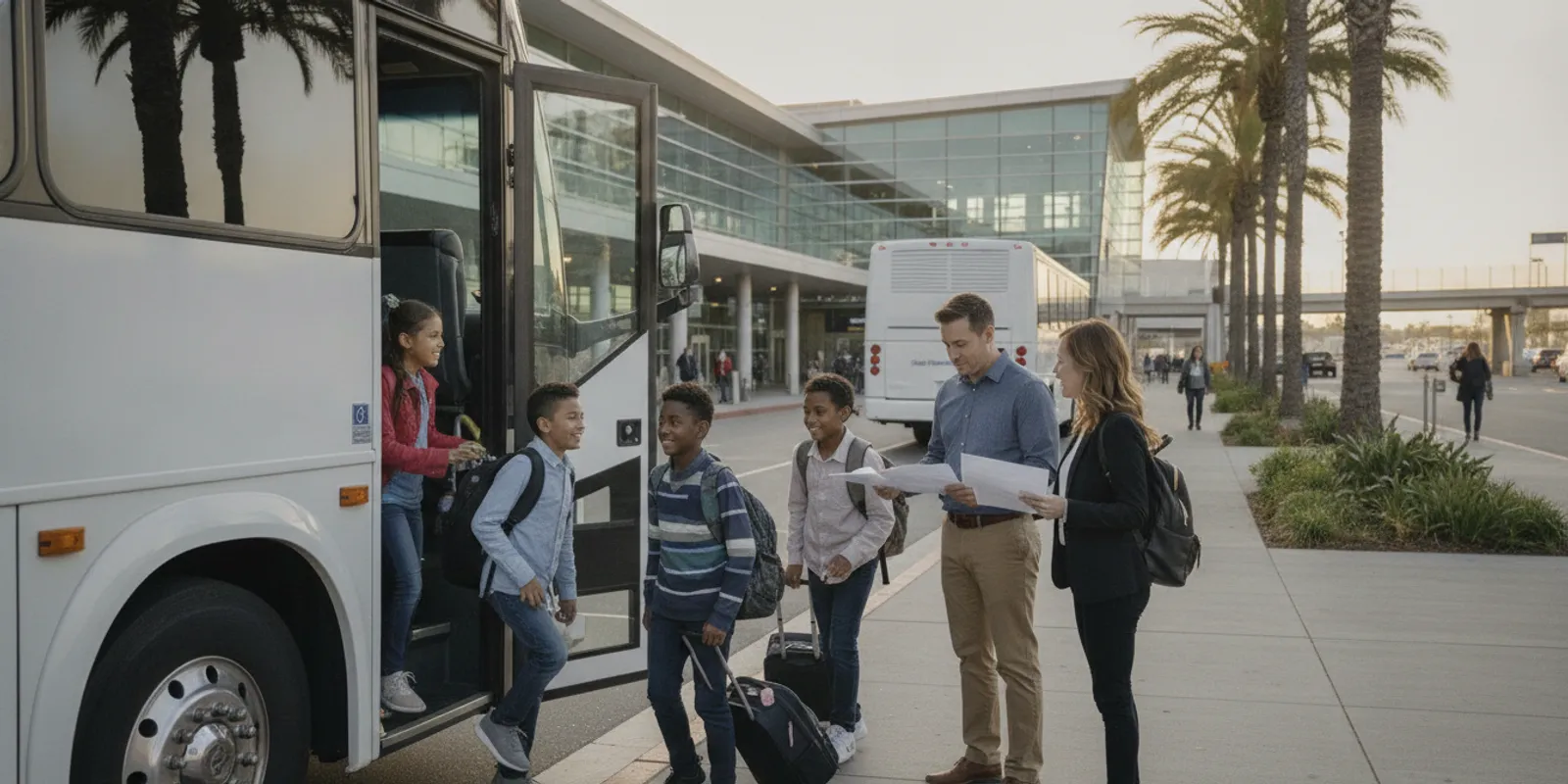
Student airport transfer planning for Bay Area schools starts with three decisions: who is traveling, which airport movements need transportation, and how students will be supervised from pickup through drop-off. Confirm those details with school leaders and families, then match the vehicle and schedule to the group rather than trying to solve everything at the curb.
Call (415) 799-2744 or Request a Quote for Student Airport Transportation.
What should student airport transfer planning for Bay Area schools include?
Start by defining the transportation job in plain terms. “Airport transfer” can mean taking a group from campus to the airport, meeting arriving students and bringing them to school, moving students between terminals or a hotel, or coordinating several arrival and departure waves. Each version has different pickup points, timing, passenger counts, and supervision needs.
Write a short trip brief before comparing vehicles or asking for prices. Include:
- Purpose and route: Identify the school or meeting location, airport, any intermediate stops, and the final destination.
- Travel dates and flight schedule: Record scheduled arrival or departure times and note whether the trip includes multiple flights.
- Passenger count: Count students, teachers, chaperones, and any other authorized riders separately. Add a process for updating the count if it changes.
- Luggage estimate: Ask what students will bring and whether oversized items, instruments, sports equipment, or mobility devices need space.
- Supervision plan: Name the adults responsible for attendance, student communication, and decisions if a flight or pickup changes.
- Accessibility and individual needs: Identify requirements privately and early so the school can discuss a suitable arrangement.
A written brief makes the request easier to understand and reduces last-minute assumptions. If the trip is an academic outing beyond an airport movement, the school can also review practical guidance for renting a field trip bus and booking a bus for a school trip.
How can you choose the right vehicle for students and luggage?
Passenger capacity is only one part of vehicle fit. A group that technically fits by seat count may still need a different arrangement if everyone has a suitcase, instrument cases, team bags, or other bulky items. Share both the headcount and a realistic baggage estimate when you ask for options. Avoid planning to fill every seat unless the provider confirms that the passenger and luggage arrangement works for the vehicle.
| Transportation option | May suit | Details to confirm |
|---|---|---|
| Passenger van or smaller vehicle | A small party with limited luggage or a short connection | Passenger limit, luggage capacity, and whether the group needs more than one vehicle |
| Minibus or shuttle-style vehicle | A medium-size school group traveling together | Seat count, baggage space, boarding location, and accessibility needs |
| Motor coach | A larger group, or a group with substantial luggage that benefits from one coordinated vehicle | Available seating and storage for the specific group, airport access and loading arrangements |
| Multiple vehicles | Several flight waves, separate destinations, or a group too large for one vehicle | Dispatch coordination, matching pickup times, adult assignments, and communication between vehicles |
This is a planning comparison, not a substitute for a vehicle-specific recommendation. Ask the transportation provider to confirm the vehicle, usable capacity, and luggage arrangement against the actual itinerary. A school can review available options on the fleet information page and learn how charter bus transportation works. For a broader overview of planning a charter, see this charter bus rental guide.
How should a school coordinate airport pickups and drop-offs?
Do not treat the airport curb as the place to settle the itinerary. Identify the exact meeting and loading plan in advance, then confirm it with the transportation provider and the school’s trip lead. Airport procedures and available stopping locations can differ, so ask where the vehicle is expected to meet the group, whether the group should wait at a designated area, and what to do if students arrive in separate waves.
For a departure, work backward from the flight schedule with the school and provider. Allow time for the drive, traffic variation, unloading, and the airport steps the group must complete. The right buffer depends on the airport, airline instructions, group size, time of day, and school policy. Avoid presenting one universal arrival time as appropriate for every trip.
For an arrival, provide flight details and a practical contact plan. If multiple flights are involved, decide whether the group will travel in separate waves or gather before departing. Set a clear rule for who may authorize a change in pickup instructions. Students should know which adult to contact and where to wait if they cannot immediately locate the group.
Schools arranging an airport run can compare the scope of a dedicated San Francisco airport shuttle service with options for a group airport shuttle. When the trip begins at a home address rather than campus, the airport shuttle pickup guide may help clarify what pickup information to prepare. Check each service’s relevance to the planned school route and request confirmation for the exact trip.
What supervision and communication plan should accompany the ride?
The school should determine its own supervision requirements and assign responsibilities before travel day. A transportation provider supplies the ride; the school remains responsible for its student policies, permission process, and chaperone assignments. Do not assume that an adult will be available to supervise students unless that responsibility has been explicitly agreed. School leaders should confirm applicable policies and guidance directly with the district and relevant education authorities, including the California Department of Education; this article is a planning guide, not a substitute for school rules or individualized student arrangements.
It helps to distinguish transportation coordination from student supervision. The provider needs accurate trip details and a reliable adult contact, while the school decides who checks attendance, communicates with families, and makes decisions for students. Put those assignments in the trip plan rather than relying on everyone to infer them. If a flight is delayed or a student is not at the agreed meeting point, the adults should know who contacts the provider, who stays with the rest of the group, and who can authorize a revised plan.
Plan for predictable points of confusion, not only the ideal schedule. An airport may be busy, students may arrive at different times, and the pickup location may require the group to move from the terminal to a designated meeting area. Decide how the trip lead will identify the group, how students will confirm they have found the correct adult, and how the school will keep the roster current. For a multi-vehicle movement, assign students and chaperones to each vehicle before boarding and agree how the lead adult confirms all vehicles are ready to leave.
Before departure, give families and students a single, current set of instructions. Explain where and when to meet, what to do if a flight changes, which adult is the primary contact, and what students should do if they cannot find the group. Avoid sending conflicting pickup directions through several channels. If the itinerary changes, the trip lead should distribute one corrected version and confirm receipt with the adults who need it.
Make the plan straightforward enough that students and adults can follow it. The trip lead can prepare a roster, assign students to an adult or group, agree how attendance will be checked at each transition, and share a method for reaching the trip lead. Decide how the school will handle a late student, an unexpected flight change, a missed connection, or a student who needs individual assistance. Keep private student information within the appropriate school process rather than circulating it broadly.
- Give chaperones the itinerary, provider contact details, pickup instructions, and an agreed escalation contact.
- Tell students the meeting point, departure expectation, and what to do if they become separated from the group.
- Use a reliable attendance check before departure and after each planned stop or vehicle change.
- Decide in advance who can approve a changed destination, pickup time, or passenger list.
- Share only the information each person needs to carry out their role.
If the airport trip is part of a larger school journey, compare the general considerations in the school bus versus charter bus guide. Schools planning longer academic transportation can also review available transportation services and confirm which arrangement fits the trip.
What should you include when requesting a quote?
A useful quote request gives the provider enough information to assess the route and group. It does not need to be complicated. Send one itinerary that includes dates, addresses or airport terminals when known, scheduled flight details, passenger and adult counts, luggage assumptions, and any special requirements. Mark information that is still tentative rather than presenting it as final.
Ask the provider to explain the proposed vehicle and what the quote includes. Request clarification about waiting time, extra stops, schedule changes, airport pickup coordination, and what happens if a flight is delayed. If the school is comparing options, ask each provider to quote against the same route, headcount, luggage estimate, and schedule assumptions. That makes the responses easier to compare.
Pricing depends on the itinerary and service details, so avoid assuming a generic rate will apply to the school’s trip. The private airport shuttle cost guide can help identify questions to ask about a price breakdown, but the provider must confirm the actual quote for the school’s plan.
| Quote detail | What to provide or ask |
|---|---|
| Route and schedule | Pickup and drop-off locations, date, time, flight schedule, stops, and return movement if needed |
| Group size | Student count, adult count, likely changes, and how separate flight groups should be handled |
| Vehicle fit | Proposed vehicle, passenger capacity, baggage space, and accessibility arrangement |
| Service assumptions | Pickup instructions, waiting time, airport coordination, and what is included in the quoted plan |
| Change process | Who to contact and how schedule, flight, passenger, or destination changes are handled |
How can student airport transfer planning for Bay Area schools support travel day?
Once the itinerary is confirmed, share a concise travel-day version with students, families, and chaperones through the school’s usual channels. Make sure the information reflects the final pickup location and time, not an earlier draft. Give the trip lead a current passenger list and a way to reach the transportation contact. Confirm the plan again with the provider as the date approaches, especially if flight or passenger details have changed.
On the day, the assigned adults can arrive early enough to organize the group, check attendance, and identify luggage before boarding. Keep students together while loading, and make sure the trip lead knows whether everyone is accounted for before the vehicle leaves. If the schedule changes, use the agreed contact path instead of asking students to relay revised instructions on their own.
For a Bay Area school, the same planning logic applies whether the trip starts in San Francisco, the Peninsula, East Bay, South Bay, or another part of the region: specify the exact pickup address, expected traffic and timing considerations, airport destination, and group needs. Do not rely on a city name alone to define a pickup location or route.
When is a dedicated group transfer a good fit?
A dedicated transfer may be worth exploring when the school wants students and luggage to travel together on a planned route, needs to coordinate a group rather than individual rides, or has several movement details to manage. It can also simplify planning when the school has a clear roster, adult assignments, and one primary itinerary. It is not automatically the right option for every group. Compare it with the school’s other approved arrangements and consider trip duration, group size, luggage, supervision, flexibility, and budget.
Epic Limousine provides ground transportation in the San Francisco Bay Area, including academic transportation and airport transfer services. Its fleet includes vehicle options across different passenger capacities; the specific match depends on the trip details. Schools can learn more about transportation services and share their requirements to discuss a suitable quote.
Call (415) 799-2744 to discuss the itinerary or Request a Quote for Student Group Transportation.
Frequently asked questions
How far in advance should a school arrange student airport transportation?
Start once the travel dates, flight schedule, and likely passenger count are available, especially if the group needs a specific vehicle arrangement. The school should ask the provider about availability and the lead time needed for its route. Confirm details again when the itinerary or roster changes.
Should students on different flights ride together?
That depends on the flight arrival times, school supervision plan, airport pickup arrangements, and how long students would wait. The school can compare one coordinated pickup with separate movements, then ask the provider how each option affects timing and vehicle arrangements.
What if the number of students changes?
Tell the provider as soon as the school knows the count has changed. Ask whether the vehicle and quote still fit, and update the passenger list and adult assignments. Do not assume a larger or smaller count can be accommodated without confirmation.
Can a school arrange transportation for students with accessibility needs?
Discuss the need with the provider early and share the relevant trip details through the school’s approved process. Ask what vehicle or boarding arrangements may be available and confirm that the proposed plan works for the student and the itinerary before finalizing it.
What information is most important for a first quote request?
Provide the date, pickup and drop-off locations, flight timing, student and adult counts, luggage estimate, and any known accessibility or schedule requirements. Identify which details are still tentative so the provider can explain what would change if the plan is updated.
A clear itinerary, confirmed supervision roles, and an honest passenger-and-luggage estimate give a school a stronger starting point for a coordinated airport transfer.
Ready to plan student airport transportation? Call (415) 799-2744 or Request a Quote.