
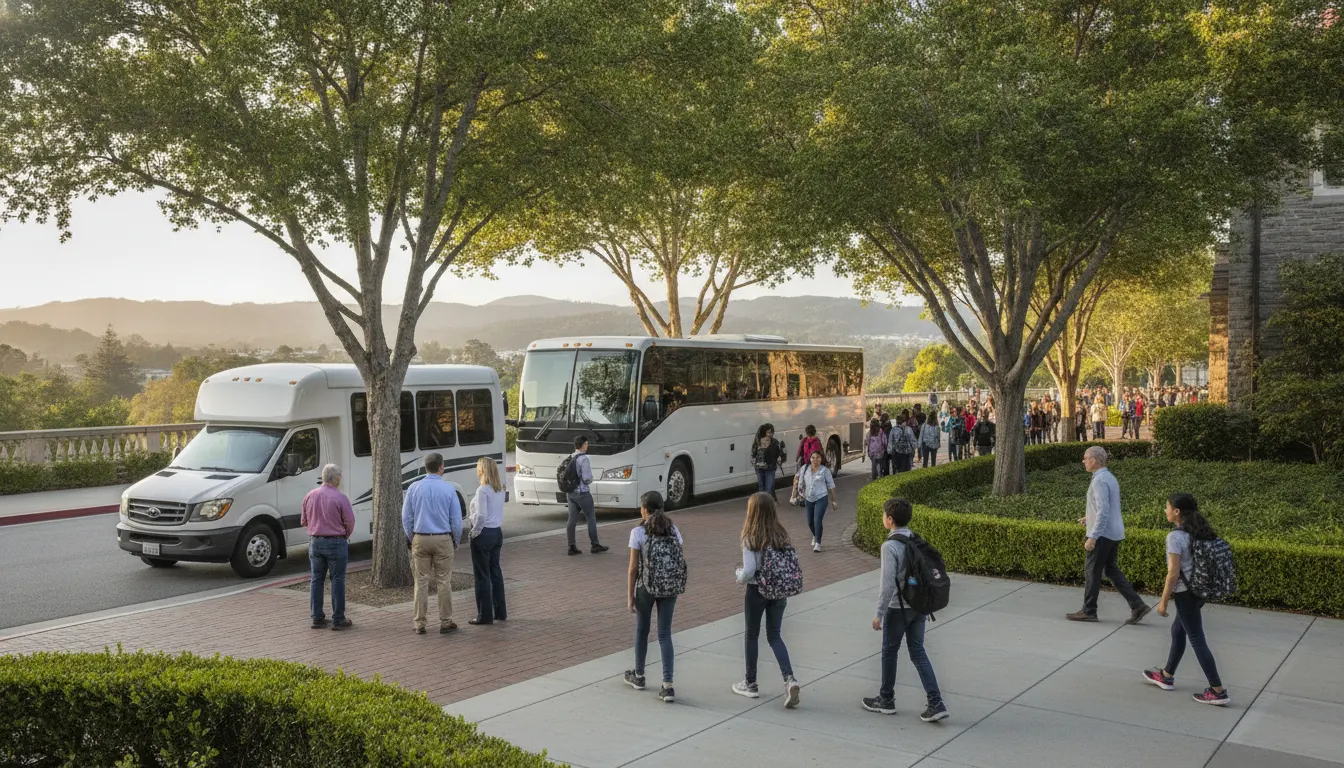
Private school transportation in the Bay Area is more than arranging a bus for a single outing. Administrators are coordinating recurring home-to-campus routes, bell schedules, athletics, campus transfers, field trips, accessibility needs, and clear communication with families. A workable plan connects each of those moving parts without making staff responsible for every delay or handoff.
A strong private school transportation plan starts with a defined service pattern, right-sized vehicles, documented loading and supervision procedures, and a provider that can adapt when the school calendar changes. Use this guide to build the brief, questions, and checklist your administrator or transportation coordinator needs before requesting a proposal.
Why private school transportation requires an operating plan
Private school transportation works best when recurring routes, occasional trips, and campus movements are planned as one connected program rather than separate bookings. The goal is predictable movement for students, families, faculty, and coaches, with clear ownership of each pickup, transfer, and arrival.
A school may need morning service from several communities, an afternoon return pattern, a midday transfer between campuses, and extra capacity for sports or activities. Those services can share information and standards, but they may not share the same vehicle, timing, or supervision model. Start by defining:
- Which students need transportation and on which days.
- Whether service is home-to-school, school-to-home, campus-to-campus, or event-based.
- Where students are released, received, and supervised at every handoff.
- Which trips are recurring and which are tied to the academic or athletic calendar.
- How families, faculty, coaches, and administrators will receive schedule updates.
- What accessibility, storage, seating, or equipment needs must be addressed in advance.
Epic Limousine’s academic bus rentals and charters page is the natural service starting point for schools comparing vehicle options and planning support. Keep the article’s recurring-route focus separate from the site’s existing field trip bus safety checklist, which is more focused on one-time outings.
Which transportation model fits a private school?
The right model depends on frequency, passenger flow, route length, equipment, and the number of supervised handoffs. A recurring route needs schedule discipline and family communication, while athletics and field trips need flexibility around changing destinations, equipment, and event times.
| School need | Planning focus | Questions to answer | Vehicle considerations |
|---|---|---|---|
| Daily home-to-campus routes | Stops, bell times, ridership, and morning or afternoon service | Where can students safely load and unload? What happens when a rider is absent? | Capacity, comfortable seating, storage, and route suitability |
| Intercampus transfers | Connection times, campus access, and receiving staff | Who confirms departure and arrival? Is a student moving with a class or individually? | Fast loading, clear visibility, and capacity at peak periods |
| Athletics and activities | Game times, equipment, return windows, and roster changes | Will teams travel together? Where will gear be stored? | Luggage or equipment space, comfort, and flexible scheduling |
| Field trips and special events | Multiple stops, meal or venue timing, and group supervision | What are the exact pickup, staging, and emergency contact procedures? | Capacity, climate control, accessibility, and storage |
For a deeper vehicle comparison, review the school bus versus charter bus guide. The decision should follow the school’s actual passenger flow and itinerary, not a generic vehicle preference.
How should administrators design recurring routes?
Recurring routes should be built backward from the required arrival time, then tested against realistic loading, traffic, and campus handoff conditions. A route that looks efficient on a map can still fail if stops are difficult to access or if students cannot be received promptly.
Use this sequence when preparing a recurring private school transportation program:
- Map the service area. Group student demand by community or corridor, then identify safe meeting points that families can reach consistently.
- Set the campus arrival window. Allow time for unloading, walking, attendance, and the start of the school day instead of targeting the bell by itself.
- Build a stop list. Record the address or landmark, loading direction, expected riders, accessibility notes, and an approved alternate location.
- Separate morning and afternoon assumptions. Afternoon dismissal, traffic, activities, and parent pickup patterns may require a different sequence than the morning route.
- Define absences and late changes. Decide who receives updates, when the route can be adjusted, and how staff document a no-show or unexpected pickup.
- Test the handoffs. Identify the school employee or authorized adult responsible for receiving students at campus and for confirming departures.
- Review after launch. Use the first weeks of service to identify stop timing, ridership, traffic, or communication changes, then update the route with the school and provider together.
Schools can borrow useful ideas from the site’s commuter shuttle service guidance, especially the emphasis on customized routes and schedules. The operating details should still be written for the school’s students, families, and campus procedures.
What safety and supervision questions should schools ask?
Safety planning should cover the provider, the vehicle, the route, and the people responsible for each student handoff. Ask for current documentation and operating procedures rather than relying on a broad promise that transportation is safe.
- What licenses, insurance documents, inspections, and school transportation credentials apply to this service?
- How are drivers selected, qualified, briefed, and assigned to recurring school routes?
- Who is the school’s day-of transportation contact, and who is the provider’s operations contact?
- How will the school handle a delayed vehicle, a missed stop, a changed game time, or an absent rider?
- Where are students expected to wait, load, unload, and transfer under normal conditions?
- How are headcounts, rosters, equipment, and authorized releases handled?
- What accessibility needs can be accommodated, and how early must the school provide those details?
- How will families and administrators receive a confirmed schedule or a material service update?
The California Highway Patrol School Bus Program is an authoritative reference for school transportation safety information. A school should also follow its own policies and obtain current provider documents during the vendor review.
How do athletics and field trips fit around daily service?
Athletics and field trips should be scheduled as separate service patterns that share the school’s communication and safety standards. This keeps a recurring route from being disrupted by a tournament while giving coaches and activity leaders the vehicle, equipment space, and timing their trip requires.
For athletic teams, prepare a roster, equipment estimate, departure window, venue address, return assumptions, and a coach or staff contact. Epic Limousine’s athletics and team travel service page and its coach bus rental guide for athletic teams address the different planning needs of team travel. Build in time for gear loading and post-game changes instead of planning only for the outbound drive.
For field trips, document the group size, chaperone count, stops, venue arrival time, meal or restroom needs, and the exact pickup procedure. The existing field trip transportation guide can support the one-time outing conversation, while this article’s focus remains the broader private-school operating program.
How should schools plan accessibility and parent communication?
Accessibility and communication should be designed before a route is quoted, not added after a student or family encounters a problem. Ask families for relevant information through the school’s established process, protect student privacy, and provide the transportation provider only the operational details needed to deliver the service.
Include these items in the planning brief:
- Mobility, seating, boarding, or other accessibility requirements.
- Approved pickup and drop-off locations for each rider or family group.
- Parent or guardian communication preferences and escalation contacts.
- Campus arrival, dismissal, and late-activity procedures.
- Roster updates, absence reporting, and the deadline for schedule changes.
- Contact instructions for coaches, faculty, and administrators during events.
When a school serves more than one campus, review the campus transportation planning guide for ideas about transfer timing and event coordination. Private K-12 schools should adapt those concepts to their own bell schedules, student age groups, and supervision policies.
What should a private school transportation quote include?
A useful quote request gives the provider enough operational detail to recommend a vehicle and schedule without guessing. It should describe the service pattern, not just the number of students, because recurring routes, campus transfers, and athletics each create different requirements.
- School name, primary contact, and decision timeline.
- Service dates, days of the week, and whether the need is recurring or occasional.
- Pickup communities, proposed stops, campus addresses, and arrival or dismissal windows.
- Estimated riders by route, grade group, and time of day.
- Vehicle, luggage, equipment, seating, and accessibility requirements.
- Field trip, athletic, or activity dates that may add service demand.
- School procedures for rosters, supervision, late changes, and emergency contacts.
- Requested billing structure, proposal format, and the person authorized to approve changes.
For larger groups, the 56-passenger charter bus planning guide can help administrators think through capacity and booking details. The Epic Limousine fleet page provides a live overview of vehicle categories, but the final recommendation should be based on the school’s route and passenger requirements.
Before sending the request, confirm that every stop is accessible, every handoff has an owner, and every schedule includes enough time for loading and unloading. That preparation makes the quote more useful and gives families a clearer service expectation.
Frequently asked questions
Private school transportation questions usually center on route design, timing, safety documentation, accessibility, communication, and the provider’s ability to support both recurring and occasional school needs. These answers can help administrators prepare a focused request.
What does private school transportation in the Bay Area include?
It can include recurring home-to-campus routes, campus transfers, athletic team travel, field trips, and special school events. The school and provider define the exact stops, schedule, vehicle, supervision process, and communication plan.
How far in advance should a school plan transportation?
Start as early as the school calendar and enrollment information allow, especially for recurring routes or dates that overlap with athletics and events. Earlier planning gives the school time to confirm stops, accessibility needs, rosters, and vehicle availability.
Can one vehicle handle daily routes and athletic trips?
Sometimes, but the answer depends on timing, capacity, equipment, and the provider’s schedule. Treat daily routes and athletics as separate service requirements, then ask the provider whether they can be coordinated without compromising either schedule.
What should a school ask about accessibility?
Ask what vehicle and boarding options are available, what information is needed, how much notice is required, and how accessible pickup and drop-off locations will be confirmed. Document the plan with the school and provider before service begins.
How can parents receive transportation updates?
The school should choose an approved communication channel and identify who sends routine schedules, delays, stop changes, and emergency instructions. The provider’s operational contact can support the school, but the school should remain clear about its family communication role.
How does a school request a transportation proposal?
Prepare the route, dates, rider estimates, campus details, vehicle needs, accessibility requirements, and contact information, then send the brief to a qualified provider. Epic Limousine can review those details and recommend a Bay Area transportation approach.
Plan a dependable school transportation program
Private school transportation in the Bay Area is easiest to manage when recurring routes, athletics, field trips, campus transfers, safety questions, and family communication are documented before service begins. Epic Limousine serves Bay Area schools and academic organizations with quote-based transportation planning. Call (415) 799-2744 or use the link below to share your school calendar and route requirements.